HOME
The Association
Situations Vacant
Articles
Publications
Calendar and Coming Events
What's New?
Site Map
Search
Contacts and Links
Short Cuts
Advertising
Audiology Refreshers 2009
Conference 2010
Constitution 2007
FAQs
Journal: Deafness and Education International
Membership
Training as a Teacher of the Deaf
MQ Annex A
Home
Home
Stay Up-to-date
XML RSS news feed for BATOD updates BATOD updates
XML RSS news feed for BATOD job postings Job Postings
XML RSS news feed for BATOD calendar and events Events
* Throughout this document/website the term 'deaf' is used to cover the whole range of hearing loss.

BATOD recognises that some ToDs use the term 'hearing-impaired' synonymously with deaf.

Articles/Being a Teacher of the Deaf/Training as a Teacher of the Deaf/Training as a Teacher of the Deaf

Training as a Teacher of the Deaf

This fact sheet, produced jointly by the British Association of Teachers of the Deaf (BATOD), the National Deaf Children's Society (NDCS) and the Royal National Institute for Deaf People (RNID), is for people thinking of training as a Teacher of the Deaf. It gives a brief description of the work that Teachers of the Deaf do, then describes the qualifications needed and how to obtain them.

This fact sheet can also be downloaded in PDF format. Download Teaching Deaf Children PDF File (99kb)

Any degree of deafness may cause significant educational and social problems. Children who are born severely or profoundly deaf need skilled teaching to develop language and communication skills (including speech and sign language as appropriate). Many children whose deafness is less severe also need special support. Teaching deaf children is stimulating and rewarding, and is made more so by continuing developments:

  • earlier and more accurate detection of hearing loss
  • greater understanding of language development
  • changing attitudes to the use of sign language
  • provision of more advanced hearing aids (including cochlear implants)
  • more informative and detailed assessment procedures.
Teaching deaf children offers a wide range of work opportunities in a number of different types of educational setting. It is challenging and stimulating work that invites initiative and gives teachers the chance to develop innovative patterns of classroom practice.

Where are deaf children educated?

Most deaf children attend mainstream schools. Some of these schools have resource bases (or units) led by qualified Teachers of the Deaf. A smaller number of children are taught in special schools some of which offer residential provision. It is a requirement that pupils in these schools and resource bases are taught by appropriately qualified specialist Teachers of the Deaf and that they obtain this qualification within three years of beginning their work with deaf pupils.

Peripatetic (or advisory) Teachers of the Deaf work for local education authority advisory and support services for deaf pupils. They support deaf children who are integrated into mainstream and special schools on an individual basis. An important part of their work is collaboration with mainstream classroom teachers who teach deaf pupils from day to day, and the management of support provided by teaching assistants (TAs) or CSWs (Communication Support Workers) who often accompany deaf pupils in lessons. Peripatetic teachers also visit parents of very young children at home to advise about the children's development and to work with them as appropriate. They also support deaf children with other disabilities.

Teachers of the Deaf may also work as part of a team in hospitals or health centres, concentrating on audiological and advisory services, particularly in the early years. Children who have cochlear implants are supported by a team of professionals including Teachers of the Deaf, Speech and Language Therapists and Audiological Scientists. Some Teachers of the Deaf specialise in Further and/or Higher Education.

How to qualify

If you are thinking of becoming a Teacher of the Deaf, it is useful to arrange a visit to a special school or resource base (or unit) for deaf pupils. Local Education Authorities' (LEA) heads of service for deaf children can give you information about these. In order to train as teachers of deaf pupils in schools or services, teachers must have qualified teacher status (QTS) and have had some classroom experience before undertaking a Teacher of the Deaf training course. All teachers of deaf children must have special training and qualifications.

There are four ways of achieving QTS:

Undergraduate Courses:
A BEd degree combines subject and professional studies with teacher training and leads to Qualified Teacher Status (QTS). Courses normally last 3-4 years. Another method is to study for a degree (BA/BSc etc.) with QTS. This combined degree includes subject studies with teacher training.
Postgraduate Courses:
The Post Graduate Certificate in Education (PGCE) combines professional studies with practical teaching experience.
Employment Based Routes:
Graduate Teacher Programme: The Graduate Teacher Programme is intended for people who have a degree, are over 24 and have some teaching or classroom experience. The programme normally lasts one year and students will generally work in school and train at the same time.
Registered Teacher Programme:
The Registered Teacher Programme is intended for people who have no degree but who have completed at least 2 years of higher education. Applicants must be over the age of 24 and have some relevant classroom experience. The programme normally lasts 2 years with students working in school while training and taking further studies.
Deaf children have an entitlement to be taught by teachers who are effective and competent. The trainee Teacher of the Deaf should usually be:
  • a qualified teacher who is effective and competent
  • an effective spoken language communicator with clear lip patterns
and should have:
  • met a range of deaf adults and children before training
  • a positive attitude towards deaf people
  • a commitment to acquire basic sign language skills to CACDP stage I or equivalent.
The trainee Teacher of the Deaf should also have:
  • high expectations of and respect for all deaf learners as individuals
  • a balanced and informed attitude towards the range of communication approaches used in the education of deaf learners
  • a recognition of the individual needs, cultural and ethnic backgrounds of deaf learners and their families
  • a positive attitude towards working in partnership with parents.

Becoming a qualified Teacher of Deaf Children

After reaching QTS, teachers usually need to gain some teaching experience before applying to undertake a Diploma/Certificate course in teaching deaf children (see Fig.1). However, any experience gained with deaf children, such as voluntary work, will support the application. It is possible to be teaching deaf pupils while gaining the necessary experience, provided such teachers are being supervised by a qualified Teacher of the Deaf.

Figure 1Fig. 1

Entry requirements for individual institutions will vary. Please contact the University directly for further information. Details about the individual courses are listed below.

One-year full-time and two-year part-time courses are offered for people who want to train as Teachers of the Deaf. Details of these are given below. Teachers who successfully complete a course are currently recognised by the Department for Education and Skills (DfES) as qualified Teachers of the Deaf. However it is likely that in future such courses will, instead, be approved by the Teacher Training Agency.

Funding

Teachers in England and Wales should ask the LEA or special school in which they work for support in taking a training course. For full-time courses this is usually by secondment on salary. Such teachers may have their tuition paid for by their employers. However this is becoming more and more unusual as the great majority of teachers in training as Teachers of the Deaf are following part-time in-service training courses whilst working with deaf children. These courses are usually financed by schools and services.

Teachers in Scotland who wish to become Teachers of the Deaf may also apply for these one-year courses. For information about financial help, contact the Student Awards Agency for Scotland (Tel: 0131 476 8212).

Even experienced teachers sometimes have difficulty in getting secondment. This is because currently such teachers are competing for support from the Standards Fund whilst many other teachers are seeking funding for other courses.

Unfortunately, neither the British Association of Teachers of the Deaf nor the Royal National Institute for Deaf People nor the National Deaf Children's Society can assist with funding.

Several organisations offer independent financial assistance to students who are self-financing. Details may be found in 'The Educational Grants Directory' by Michael Eastwood and David Casson, published by the Directory of Social Change. This is available in most public libraries and will be useful for those who are trying to obtain financial support.

Deaf teachers

Deaf people who have the relevant qualifications are encouraged to apply to train as Teachers of the Deaf. Their contribution to the education of deaf children is particularly valuable. They should discuss their application and support needs for study with the University to which they are applying. The earlier this is done, the better.

The full list of courses available in England, Scotland and Wales is as follows:

Full time courses

The University of Manchester
The University of Manchester awards the University Post Graduate Diploma in Deaf Education. This requires one or two years on campus or two years distance learning. For details send an email to: pg.psychology@manchester.ac.uk; website: http://www.psych-sci.manchester.ac.uk/graduatestudy/pgdipasehic/

Part-time courses

The University of Birmingham
The School of Education offers a two-year programme of study by distance education, leading to BPhil (Ed) or Post Graduate Diploma in Education (Special Education - Hearing Impairment). The programme is open to qualified teachers, normally with not less than two years' teaching experience. Students who successfully complete the work for the Postgraduate Diploma may then progress to MEd.
Applications are also invited from students who are not qualified to teach children but who are working with deaf pupils/students (CSWs, Tutors supporting deaf pupils in FE etc). These students are entitled to study for the University award (BPhil or PG Diploma) but do not normally undertake the assessed practical element of the programme and are not eligible to obtain qualified teacher of the deaf status.
Details from: The Receptionist, School of Education, The University of Birmingham, Edgbaston, Birmingham B15 2TT.
Tel: 0121 414 7168; Enquiries to Linda Watson Tel:0121 414 4876, email: L.M.Watson@bham.ac.uk

The University of Edinburgh
The University of Edinburgh offers a part-time modular programme leading to the award of Postgraduate Diploma in Additional Support for Learning (Deaf Education) or Masters (MEd). The Diploma programme normally takes two years and consists of six courses. One of these courses is a placement which takes place in the teacher's own workplace (4 weeks) and in another setting with deaf learners (3 weeks). Those who successfully complete the Diploma can progress to the MEd, which can take an additional one or two years. Further details from The Moray House School of Education, The University of Edinburgh, Holyrood Road, Edinburgh EH8 8AQ. Contact the course tutor, Rachel O'Neill, for more details. Tel: 07961661788 or rachel.oneill@ed.ac.uk website: www.ed.ac.uk

The University of Hertfordshire
The University of Hertfordshire offers a Post Graduate Diploma/MA (Ed) in Education of the Hearing-Impaired/Deaf, full or part time. Individual modules can also be taken.
Details from: The Admissions Office, Faculty of Humanities and Education, University of Hertfordshire, Hatfield Campus, Hatfield, Hertfordshire AL10 9AB
Tel: 01707 284800; Email: admissions@herts.ac.uk website: www.herts.ac.uk

The University of Leeds
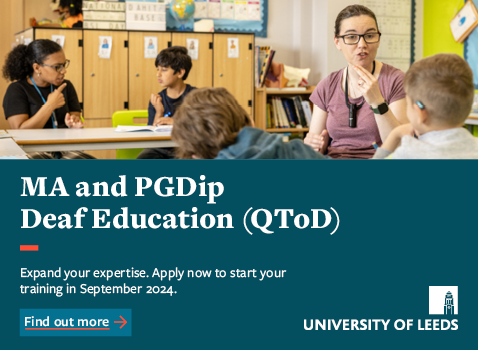
The University of Leeds offers a two-year course leading to an MA in Deaf Education (Teacher of the Deaf Qualification). This is offered as a distance course involving school-based learning with distance learning materials and support from the university tutors.
Details from Dr Ruth Swanwick, School of Education, University of Leeds LS2 9JT. Tel: 0113 343 4582 (direct line, voice and text) email: R.A.Swanwick@education.leeds.ac.uk

From September 2009 University of Leeds will be running a new MA in Deaf Education International at the University of Leeds. This is a distance education programme for International part-time students which will be taught totally on-line using the University's new Virtual Learning Environment. Programme for MA Deaf Education International

The University of Manchester
The University of Manchester awards the University Post Graduate Diploma in Deaf Education.. This course may also be available in distance learning mode. The University also offers a two-year distance course for teachers and other professionals who work with children or adults who are sensory impaired and have severe or profound learning difficulties. The course is offered at Advanced Diploma and Masters Level. A certificate course is also available for parents and carers. The University also has a distance learning course for an M Ed (Hearing Impairment). This is for qualified Teachers of the Deaf who wish to undertake further studies. The course units may be taken free standing or as part of the M.Ed. New modules include: developing infant 0-2 years; early audiological management; working with families and other professionals. These have been developed specifically to meet the new challenge resulting from the introduction of Newborn Hearing Screening.
Details by email from pg.psychology@manchester.ac.uk

The University of Oxford Brookes
Oxford Brookes University, working with Mary Hare Grammar School for the Deaf has a course leading to a Post Graduate Diploma in Educational Studies (Hearing Impairment). This course is available over two years, part time. The modular curriculum is taught during 12 residential weekends over two years. The course has six modules, and assessment is by course work.
Details from: Carol Ward, Oxford Brookes Course Secretary, Mary Hare School, Arlington Manor, Snelsmore Common, Newbury RG14 3BQ Tel: 01635 244200; fax 01635 248019

The University of Wales College, Newport
This is a 2-5 year part-time course meeting usually weekly after school. There is currently no residential component. The course leads to MA Special Educational Needs (Hearing Impairment).
Details from: The University Information Centre, University of Wales College, PO Box 101, Newport NO18 3YH Tel: 01633 432432; Fax: 01633 432850.

Contact Information (Click to send Email)