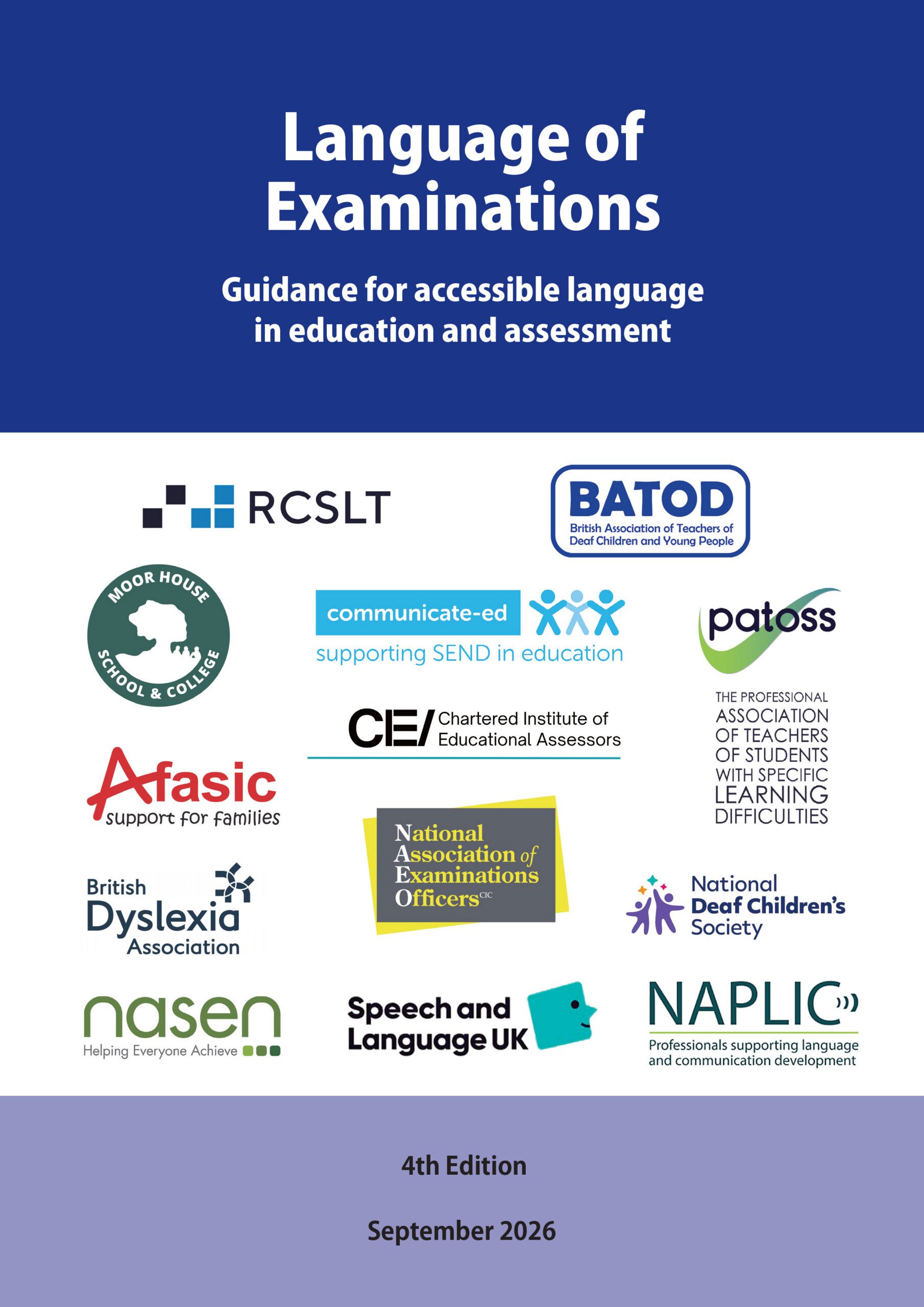

Language of Examinations – Fourth edition
Language is central to learning, teaching, and assessment and may be expressed and accessed in different ways. Assessments should enable learners to demonstrate what they know, understand, and can do without being disadvantaged by unnecessary linguistic barriers.
Language of Examinations has a longstanding history of promoting greater linguistic accessibility in assessment. Earlier editions focused primarily on improving access for deaf learners and established principles of language modification that have influenced practice over many years.
This fourth edition builds on that important foundation while reflecting developments in research, policy, and professional practice. It reflects the growing evidence that the language used in examinations and other assessments may also present barriers for learners with developmental language disorder (DLD); language disorder associated with a biomedical condition; autism; speech, language and communication needs (SLCN); specific learning difficulties (SpLDs), and other learners who experience language and communication barriers in assessment.
This edition also reflects an important development in approach. Rather than considering accessibility only after an assessment has been produced, it promotes accessibility by design: anticipating and reducing unnecessary linguistic barriers. throughout teaching, learning, and the assessment-development process. This supports continuity with a learner’s normal way of working so that appropriate language accessibility is embedded in everyday educational practice rather than introduced only at the point of formal assessment. This does not replace modified papers or other reasonable adjustments, which remain essential for some learners, but provides an opportunity to improve language accessibility from the earliest stages of teaching and learning through to formal assessment.
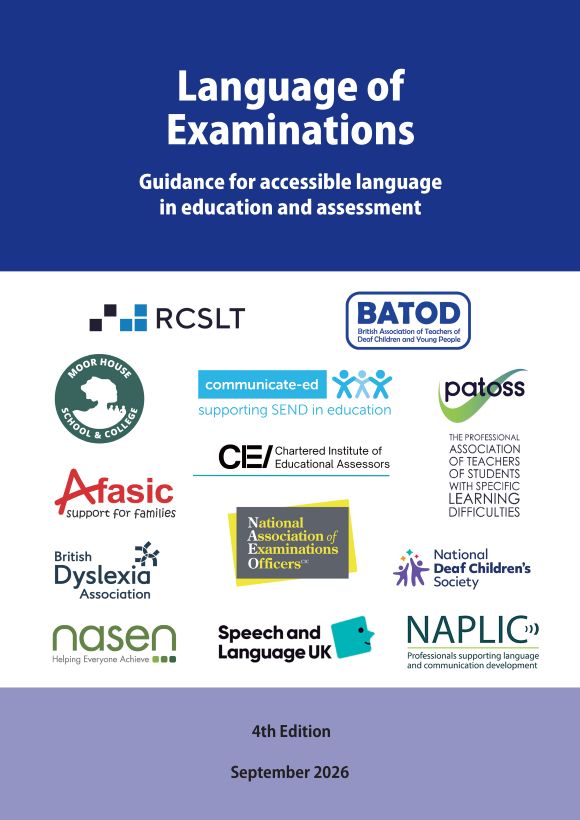
This edition was made possible due the partnership working with the following organisations:
- Afasic
- British Association of Teachers of Deaf Children and Young People (BATOD)
- British Dyslexia Association (BDA)
- Chartered Institute of Educational Assessors (CIEA)
- Communicate-ed
- Moor House School & College
- National Association of Examinations Officers (NAEO)
- National Association of professionals supporting language and communication (DLD) (NAPLIC)
- National Association of Special Educational Needs (nasen)
- National Deaf Children’s Society (NDCS)
- Professional Association of Teachers of Students with Specific Learning Difficulties (Patoss)
- Royal College of Speech and Language Therapists (RCSLT)
- Speech and Language UK
The working group is also grateful to colleagues from awarding bodies, regulators, and other organisations who have generously shared their expertise, provided constructive feedback, and supported this guidance.
Above all, we recognise the commitment of the many QToDs, SaLTs, specialist teachers, specialist assessors, classroom teachers, special educational needs coordinators (SENCos), additional learning needs coordinators (ALNCos), learning support coordinators, support for learning teachers, educational psychologists, researchers, examination writers, language modifiers, and other educational professionals whose knowledge and experience continue to advance accessible assessment practice across the UK.
*For support linked to vision impairment contact Royal National Institute of Blind People (RNIB) and vision impairment education workforce (VIEW)